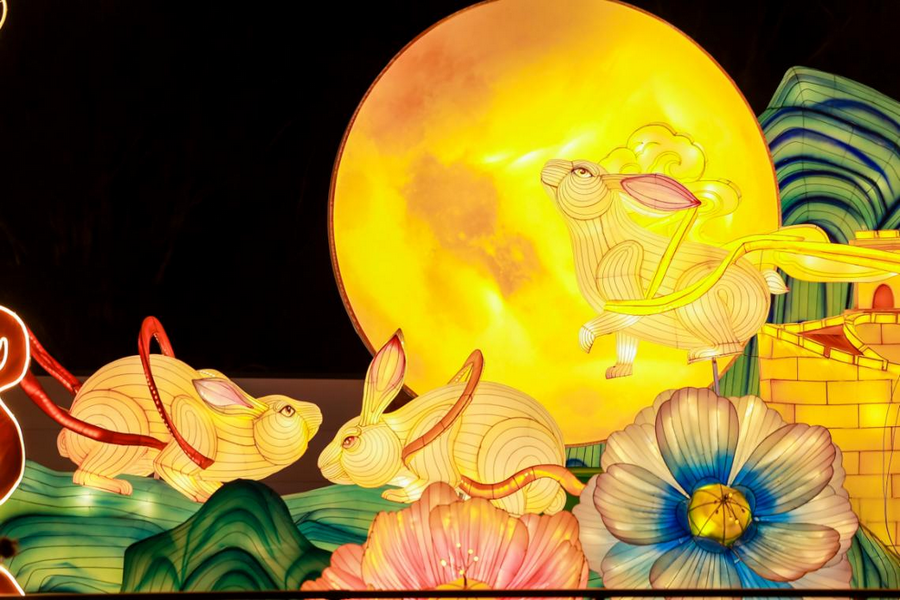
Jade Rabbit
Introduction
The Jade Rabbit, or Yutu, is a significant figure in Chinese culture, deeply intertwined with mythology, folklore, and modern symbolism. As a mythical creature, the Jade Rabbit is traditionally depicted as a companion of Chang'e, the goddess of the moon. It is often portrayed as diligently pounding the elixir of immortality with a pestle and mortar under a mystical osmanthus tree. Its cultural significance has transcended time, from its origins in ancient mythology to its role in modern scientific endeavors, notably China's lunar exploration missions which have named their lunar rovers after this legendary figure.
Mythological Origins
Chinese Mythology
In Chinese mythology, the Jade Rabbit is an integral part of the legend of Chang'e, the moon goddess. The story originates from the time when ten suns scorched the earth. Hou Yi, a skilled archer and husband to Chang'e, heroically shot down nine of these suns to save humanity. As a reward, Hou Yi was given an elixir of immortality. However, he chose not to consume it, wishing instead to remain with his beloved wife. The story takes a dramatic turn when Chang'e, to prevent a thief named Peng Meng from stealing the elixir, consumes it herself. This act causes her to ascend to the moon, leaving Hou Yi behind. There, she is accompanied by the Jade Rabbit, who tirelessly attempts to prepare an elixir to reunite Chang'e with her husband, a task that symbolizes eternal dedication and resilience.
Significance in Folklore
The Jade Rabbit's significance is not limited to its mythical origins; it is also a prominent figure in Chinese folklore, particularly during the Mid-Autumn Festival. This festival, a time for family reunions and moon worship, features the Jade Rabbit as a symbol of longevity and fulfillment. The rabbit’s association with mooncakes—traditional pastries prepared during the festival—adds another layer of cultural depth. The Jade Rabbit, tirelessly pounding away in its celestial abode, embodies both the nostalgia and the hope inherent in these celebrations.
Cultural Symbolism
The Jade Rabbit transcends its mythological roots to serve as a symbol of various virtues in Chinese culture. Its association with the moon aligns it with notions of purity and tranquility. The rabbit's industrious nature is emblematic of diligence and perseverance, traits revered in Chinese society. Moreover, as a creature associated with the moon, the Jade Rabbit is seen as a symbol of regeneration and immortality. These attributes contribute to its status as an auspicious animal in Chinese zodiac traditions. In this context, those born in the Year of the Rabbit are often perceived as gentle, humble, and meticulous, reflecting the qualities of the Jade Rabbit.
Jade Rabbit in Literature
The Jade Rabbit has been a muse for many Chinese poets and writers throughout history, often appearing in literary works as a symbol of longing and introspection. The renowned poet Li Bai captured the melancholy of the Jade Rabbit’s ceaseless labor in his poems, drawing parallels between the rabbit’s mythic endeavors and human experiences of desire and unattainable goals. Similarly, Du Fu and Su Shi, other luminaries of Chinese literature, used the motif of the Jade Rabbit to explore themes of solitude and the quest for meaning, often set against the backdrop of the Mid-Autumn Festival. These literary works have helped cement the Jade Rabbit’s place in the cultural consciousness, resonating with readers who see in it a reflection of their own aspirations and struggles.
Jade Rabbit in Popular Culture
In contemporary times, the Jade Rabbit has permeated popular culture, both within China and internationally. Its image can be found in a wide array of artistic expressions, from traditional jade carvings and ceramics to modern cartoons and digital media. The Jade Rabbit's enduring appeal lies in its versatility as a cultural icon—it is at once a mythical creature, a symbol of scientific achievement, and a beloved character in children's stories. This multifaceted identity allows the Jade Rabbit to bridge the gap between ancient traditions and modern innovation, making it relevant to successive generations.
Scientific Interpretation
The Jade Rabbit's influence extends beyond mythology and culture into the realm of modern science. China's lunar exploration program, named after the legendary figure, underscores the symbolic connection between the Jade Rabbit and the moon. The Jade Rabbit-2, part of the Chang'e-4 mission, is a testament to this synthesis of myth and science. As the longest-working lunar rover on the moon, the Jade Rabbit-2 embodies human curiosity and the relentless pursuit of knowledge. This scientific endeavor not only pays homage to Chinese mythology but also symbolizes China's aspirations in space exploration, merging cultural legacy with cutting-edge technology.








